Ridley Hall to Bardon Mill
We start the day with the song of the blackcap as we leave our road verge parking spot outside of Haltwhistle.
We follow a minor road which is distinguished by a land of well-kept wealth – large houses, manicured gardens, dog training areas and walled gardens – a family of mallard ducklings taking refuge by a pretty cottage amidst hopping bunnies and jackdaws – some kind of Beatrix potter scene unfolds.
We stray off the designated footpath on the road and take a short track down to the river’s edge. Mounds of pebbles, sunshine, the shelter of tress, a pair of sandpipers twittering, a little idyll. We stop and eat a sandwich. We skim a stone and watch the sandpipers bobbing as they flow from rock to rock inspecting the world beneath them. We try bobbing ourselves. Does it somehow come from the river? We find our own human versions. What feels good for our upright bodies? It’s fun.
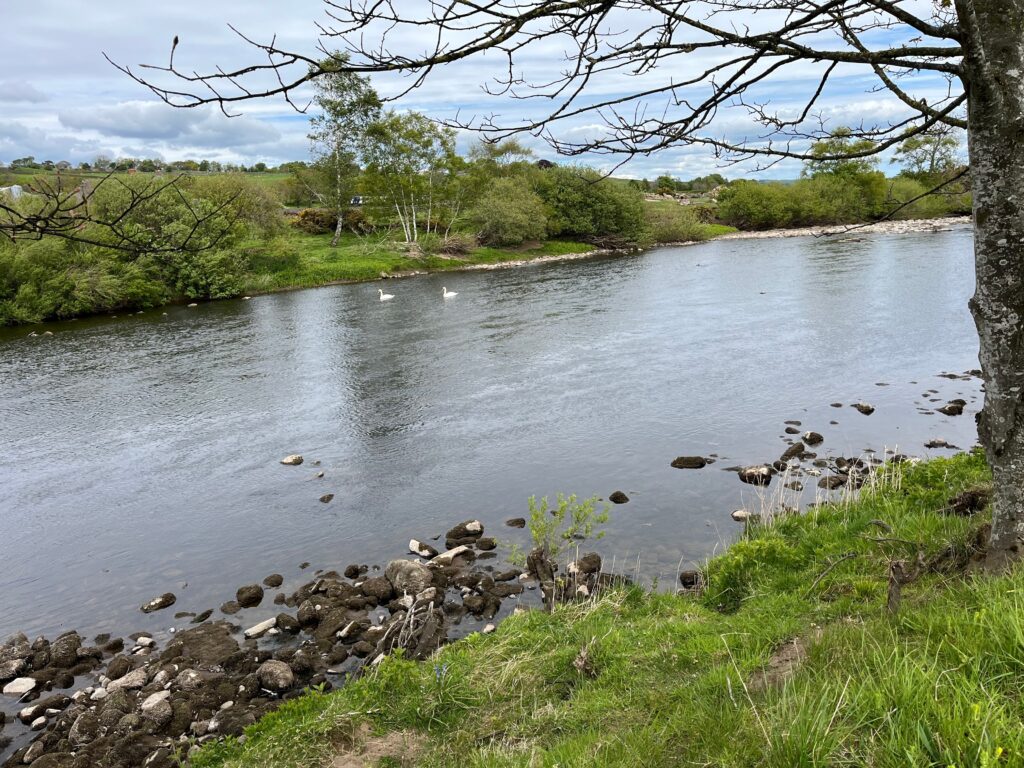
We notice an informal track – A rabbit track? A human desire line? – along the edge of the river and risk following it with the chance of getting stumped somewhere round the corner. We find ourselves on a narrow strip of wild, separating farmland exclusively of rye grass and sheep from a riverbank of red campion, crosswort, cranesbill, nodding heads of water avens, hummocks and old trees. The river has preserved this riot of diversity and irregularity with it’s steep rocky banks.
Malcolm is lamenting the absence of goosander, when a female appears with 6 ducklings. It’s happened 4 times in a row that we have lamented an absence and as if in contradiction or in summoning, it appears. Goosander, Sandpiper, Dipper, Grey Wagtail. But the dippers are fewer in number – is this an indication of polluted water? We wonder about the pipes from nearby fields spilling ‘who knows what’ into the river, painting the rocks below bright orange.
At Willimoteswick again we follow the river rather than the track – another narrow band of wilderness – bends in the river where stones are piled, creating habitats for an abundance of life. As if to exemplify this ‘human nether region’ we encounter a young couple ‘in flagrante’ on the path, who as we pause, hurry to cover themselves and stand separately behind trees facing away from us as we pass. An echo of the old folk songs.
Thrift grows in the calaminarian grassland. The spoil of industry providing habitat for new life.
We pass the Beltingham yew tree, 1000 years of life, held together by it’s Victorian belts. We notice the graves of Northumberland fusiliers – Thomas Tweeddale. A guest in the pub we stay in that night tells us of the first world war cemetery she lives near to in Belgium, called Tyne Cot. It was named by the Northumberland fusiliers after the cottage-like shapes of the German bunkers. How central a place the river plays in our identities, that we carry and seek refuge in, even through war. A last effort up to Moralee tarn – a piece of particularly Victorian beauty – before reaching our waiting car. Now noticing it parked under a wide old Ash tree, completely devoid of leaves and beginning to shed it’s branches.